ABOUT US


Bat Futures
Vision for designing interconnected Bat corridors in London (by 2040)
Our Intent
Four UK bat species are nationally at risk, yet existing conservation efforts often fail to address the complex, interconnected challenges across the city. This project explored plausible and preferable futures for bats and humans to coexist in London by 2030 and 2040, focusing on safe roosting, feeding, and navigation within urban environments.
To develop more-than-human, co-designed interventions that promote bat conservation in cities by engaging experts, community members, and stakeholders to envision interconnected urban habitats, green corridors, and sustainable coexistence strategies.
Key Outputs
-
Workshops & co-design interventions:
-
Storytelling workshops to uncover community perceptions and biases about bats
-
Expert workshops involving conservationists, planners, and city representatives to envision London-wide strategies
-
-
Prototypes & tools: Facilitation toolkit for future workshops, visual systems maps, and interactive scenario-building exercises
-
Insights & strategy: Identification of leverage points for safe roosting, mitigation of friction factors (light, noise, chemicals), and frameworks for collaborative city-wide conservation efforts
Aim

Role:
Futures Designer & Strategist
Duration:
3 months
Industry
Urban Ecology & Conservation Design
Team:
5 members
The Problem
Four of the 11 Red Listed British mammals at risk of national extinction are bats.
The greater mouse-eared bat is Critically Endangered, reduced to two individuals.
The grey long-eared bat is Endangered.
The barbastelle and serotine are both Vulnerable Bats.
Chiroptera spp are one of the 7 target species for London Biodiversity Action Plan 2021-26.
1
2
3
4
5
.png)
Research Methods
We structured our secondary research using a STEEP framework and a timeline analysis to trace how human–bat interactions and relationships have evolved and influenced each other from the past to the present.
Secondary research
Particularly since Ming Dynasty (1368-1644)
Bats considered symbols of good luck in China
Social
Middle Ages (476 - 1500)
Spread of superstitions and associations of bats with evil, witchcraft, and diseases in Europe
Social
Second Industrial Revolution (1870-1914)
Massive use of building materials and consumption practices
Tech
Env
Post WWII Start of intensive agriculture, with use of chemical fertilisers
Tech
Env
1981
The Wildlife and Countryside Act
Politic
1997
Implementation of the National Bat Monitoring Programme
International Bat Night
Annual event promoting awareness and education about bats
Political
Late 20th century
Beginning of the Modern Nature Conservation movement in the UK
Env
2002
City of London Biodiversity Action Plan (BAP)
Env
2001
European Bat Conservation Strategy
Env
2005
iBatsUK project
Env
2006
The first cases of White Nose Syndrome (WNS) were reported in the United States
Env
2008Global Economic Recession, significant budget cuts including environmental conservation
Economic
Tourism Growth (2000s-present)
Can benefit bat conservation by promoting awareness and funding, or can disturb roosts and habitats
Economic
Social
2012 National Planning Policy Framework (NPPF)
2015
Sustainable Development Goals (SDGs)
Political
Env
2017
Habitats Regulations
2010s - present:
Development of Renewable Energy
Env
Tech
2021
The UK Environment Act
Political
Env
Political
Political
Env
Future
Decrease of insects
Rise in temperatures
New technologies improving bat monitoring
AI Development, energy and water demand, habitat loss,
Sustainable agriculture innovations
Increase of pandemics and zoonotic diseases
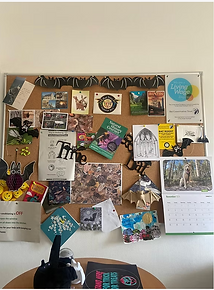
Conducted expert interviews with specialists from the Bat Conservation Trust and UCL, and complemented this with site visits to the Bat Conservation Trust office and the Natural History Museum to deepen our understanding of bat ecology and conservation practice.
Primary research

Snapshots of studying bat biology, behaviour, and ethology

In conversations with Joanna Ferguson and
Dr. Ella Browning


Elicitation Workshop
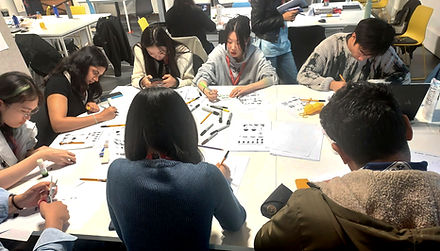
Our first probe was a storytelling workshop designed to surface people’s existing worldviews, cultural associations, and emotional responses toward bats inform public attitudes toward bats as an urban species.
To uncover these underlying biases and emotions, participants were asked to assign an emotion to bats and create a short comic with a bat as the main character. We provided stickers representing common influencing factors like insects, cats, buildings and artificial lighting, elements that interact with or impact bats daily.
This allowed participants to construct narratives freely while engaging with real ecological touchpoints. After creating their comics, participants shared their stories with the group, giving us a window into cultural meanings and assumptions embedded in their perceptions.
Synthesis of the workshop
Through thematic analysis of the workshop outputs, we found two distinct clusters of perception:
Negative associations: bats linked to disease, darkness, vampires, fear, and long-standing myths.
Positive associations: bats as symbols of healing, nature, and environmental protection highlighting growing ecological awareness across demographics.


Research Synthesis
To understand the interconnected factors affecting bat populations in London, we created a systems map capturing all variables linked to bat mortality. This helped us identify causal loops, dependencies, and key leverage points.
Systems Mapping

Map 1

We then translated the map into a clearer visual structure showing: the bat ecosystem,the human ecosystem, and their interaction zone.
This revealed how urban behaviours - light pollution, construction, chemicals, noise, pets, and habitat fragmentation, directly influence bat roosting, navigation, and survival. At the same time, it highlighted the essential ecological services bats provide, such as natural pest control and pollination.
_page-0002.jpg)

Leverage points
Bats are losing safe, connected zones in the city due to human-driven pressures, both direct (urbanisation, pollution, climate change) and indirect (pesticides, insect decline).
Isolated solutions are not enough - roosting sites only work when the surrounding environment (lighting, vegetation, noise) supports bat activity. Light pollution emerged as a major disruptor. Because many bats are migratory, London needs city-wide green corridors linking existing and future safe zones. A key leverage point is the need for coordinated, cross-borough collaboration, as current conservation efforts are fragmented and operate in silos.These insights directly informed our intervention strategy and workshop model.
The Intervention Vision
Our vision is to create a London where bats can access a connected network of safe roosting and movement zones ecological corridors that exist in harmony with people. We found that although bat conservation work is ongoing, it largely occurs in silos. These efforts often overlook broader systemic factors that shape bat survival, including artificial lighting, urban development, noise pollution, land-use planning, and habitat fragmentation. As a result, isolated interventions, are harder to scale into long-term, resilient ecological networks.
We recognised that lasting impact requires collaboration across the human systems that shape bat habitats. Conservationists alone cannot address these challenges. Borough councils, planning authorities, architects, construction teams, landowners, and local communities all influence whether bats can thrive.
Intervention Strategy
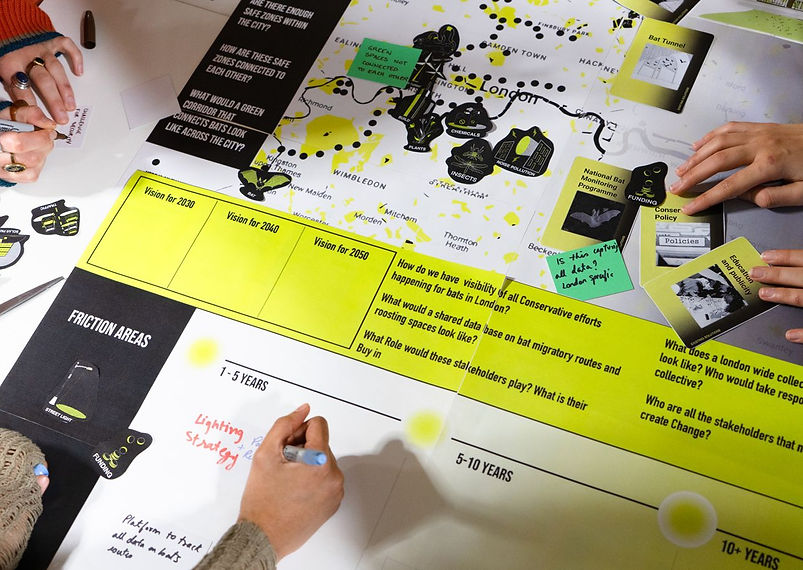
Our strategy proposes bringing these diverse stakeholders together to collectively map out what is needed to achieve a shared vision for bats in 2030, 2040 and 2050.
.png)
1
Convene key influencers
Bat experts, conservationists, urban planners, architects, council members, builders, and activists - to establish the scope of work needed and align on long-term goals.

2
Create a shared understanding
Create a shared understanding of the issue by examining how bats currently navigate, roost, and survive across the city, and how human systems disrupt or support these pathways.

3
London-wide conservation effort
Co-develop a London-wide conservation effort, focusing on collaboration over isolated initiatives, shared learning, and scalable practices.
Workshop Flow 1
“A Day in the Life of a Bat”
Participants: Bat conservationists - We begin by inviting experts to map a bat’s daily cycle - from roosting to feeding to navigating London at night.
This shift into a bat-centric perspective helps surface daily friction points:lighting, noise, chemicals, domestic predators, habitat gaps. We provide curated stickers representing common disruptors, blank stickers for new discoveries, and solution cards (QR-linked for detail). These help provoke discussion on existing practices, blind spots, and systemic disconnects across conservation efforts.
Key provocations:
“Is conservation happening in the right places? Do they talk talk to each other?"
"Are conservation efforts taking all influencing factors into consideration?"

Workshop Flow 2
1. “A Year in the Life of a Bat”
Participants: Conservationists, construction professionals, activists, borough council teams, community members.
Building on from workshop 1, participants use the day in the life of a bat to understnd friction points effecting bats to then zoom out to consider seasonal behaviours and year-long patterns - migration routes, breeding cycles, winter roosting, and movement between habitats.
Here, they will explore:
"What does a safe zone look like? How can these become a connected network across London?"
"What city-wide interruptions exist? This phase made visible the complexity of designing for an entire urban ecosystem rather than a single intervention site."


2. Visioning & Mitigation for 2030 / 2040 / 2050
Participants: Cross-sector stakeholders
The final activity will invite participants to co-create long-term strategies for a bat-friendly London.
Together they will:
Articulate ecological visions for 2030, 2040, and 2050.
Identify mitigation pathways - Prioritise interventions, mapp responsibilities across sectors. Surface opportunities for shared governance.
This phase emphasises the importance of cross-sector alignment: to build ecological corridors that are feasible, scalable, and embedded within London’s infrastructural future.
![map 3 [Recovered].png](https://static.wixstatic.com/media/40d78f_2a5821a3d12442eb83b40b84bbef9c0a~mv2.png/v1/fill/w_494,h_353,al_c,q_85,usm_0.66_1.00_0.01,enc_avif,quality_auto/map%203%20%5BRecovered%5D.png)

