ABOUT US
Sustainable Packaging for Railway Service
Client Brief
A client project under Madlab for the client ID Fresh Food.
The brief was to design sustainable, cost-effective packaging for ID’s railway segment (fresh menu) with freedom to explore alternative, non-plastic materials.
Aim
Design environment-friendly packaging that is easy to store, carry, dispose and eat-from while preventing leakage of liquid food.
Key Challenges
-
selecting an appropriate material (natural vs reusable)
-
packaging liquid items without plastic usage
-
separating wet + dry food without mixing
-
making consumption easy while standing (railway context)
-
ensuring stackability and thermal comfort


Role:
Product Designer. Designed one of the final packaging outcomes that went into production
Duration:
3 months
Industry
Packaging + Material Innovation
ID
Research Approach
We conducted on-ground visits to ID outlets in Chennai to analyse current packaging issues.We observed:
-
Leakage led to liquid mixing with solid items → sogginess
-
Aluminium packs became too hot to hold while standing on platforms
-
Poor balance → difficult to eat upright
-
Multiple parcels needed to be stackable and easy to carry
-
We also analysed ID’s menu categories to design compartment logic based on food behaviour (liquid / semi-liquid / solid).

ID Food Analysis
.png)
Material Exploration

CLAY
BAGASSE
BANANA LEAF
ALUMINIUM
FOIL
CARD
BOARD
A

Banana Leaf
.png)
Pros
-
Easy to procure and transport
-
Portrays the nature of south Indian packaging and enhances the overall aesthetics
Cons
-
Can be used mainly as secondary packaging
-
Cannot be stored for a long time
C

Cardboard
%20-%20Copy.png)
Pros
-
Cardboard can be recycled
-
It provides a sturdy structure
Cons
-
Cannot be used for liquid food
-
Only geometrical shapes can be formed and not organic
E
Aluminium

.png)
B

Bagasse
.png)
Pros
-
Aesthetically appealing
-
Can be sealed using banana leaves/ aluminium/butter paper
Cons
-
Environmental impact is higher during manufacturing process (considering water and power use)
-
Final cost is higher then most options
Areca Nut
D

.png)
Pros
-
Easy manufacturing process
-
Strong and sturdy to use
-
Can be shaped and compartmentalized
Cons
-
Cannot be leak-proof as structure does not comes out uniform in manufacturing
-
Raw material quality is inconsistent
F
Clay

%20-%20Copy.png)
Pros
-
Available in multiple shapes and sizes
-
Cheap manufacturing process
-
Keeps food warm for long amounts of time
Cons
-
Leakage from one compartment to another
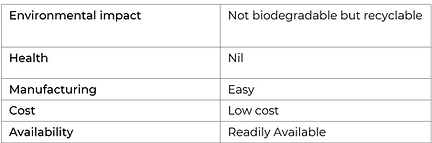
Pros
-
Same manufacturing as plastic (available in numerous options)
Cons
-
Biodegradable only under Industrial conditions
(collection and segregation is hard after usage)

After analyzing the various pros and cons of different materials, we ideated taking into consideration, the
• Durability
• Environment-friendly material
• Stackability
• Ease of use
• Least material wastage
• Spill Proof


Ideation
Prototypes
Trial 1
Material: Cardboard + Aluminium/Bagasse/Kullad pots
Ease of use: Can be held with one hand
Stackability : 70% efficient
Spillage: 95% prevented
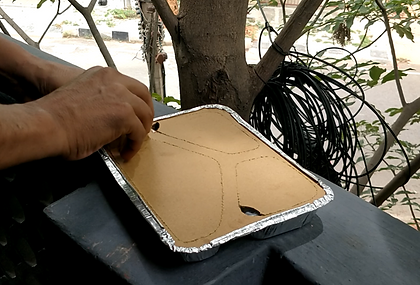
Material: Aluminium + Cardboard
Ease of use: Hard to hold with one hand
Stackability: 9 7% efficient
Spillage: 80%prevented
Trial 2



Concept 1

Rubber Bands
Banana Leaf
Burnt Banana Leaf
Cardboard
Packaging
Clay Pots
Assembly and Packaging
Unwrapping

Concept 2

Rubber Bands
Burnt Banana Leaf
Banana Leaf
Clay Pots
Cardboard
Packaging
Assembly and Packaging
Unwrapping
Baggase Concepts
Experimenting with the lips to provide a sound structure and at the same time prevent spillage
-
Separating the compartments using multiple depressions to prevent spillage
-
Separating the compartments with an extrusion by increasing area

A
B
Inspired from a tiffin box and exploring the possibility of completely separating the liquid from the solid food with the main dish on top and the liquid underneath

C
Separate lids for chutney and sambhar with one overall lid to prevent spillage with the application of pressure from the top lid.


1
Basic

2
Kids Meal

3
Combo

4
Tiffin Box